
Standing Still Can Be Uncomfortable (And Also Wise)
July 31, 2026
The desire to perform all the time is usually a barrier to performing over time
—Robert Olstein
Patience is easiest to admire in hindsight and hardest to practice when everyone else appears to be making money.
That pressure seems particularly strong when a highly anticipated company enters the public markets. Early gains create urgency. Headlines reinforce the excitement. Waiting can begin to feel less like discipline and more like an opportunity slipping away — and this summer, no debut generated more of that feeling than SpaceX.
What makes these moments difficult is that the discomfort is real. Nobody enjoys standing still while others appear to be moving. But the feeling of falling behind and the fact of falling behind are two very different things, and markets have a long history of rewarding investors who can tell them apart.
This month’s Note examines the excitement surrounding initial public offerings (IPOs), how the fear of missing out can influence investment decisions, and why a disciplined, repeatable investing process asks a different question than the crowd.
But first, here’s a summary of the global asset classes utilized in our portfolios and their exposures for August.
Asset Allocation Update
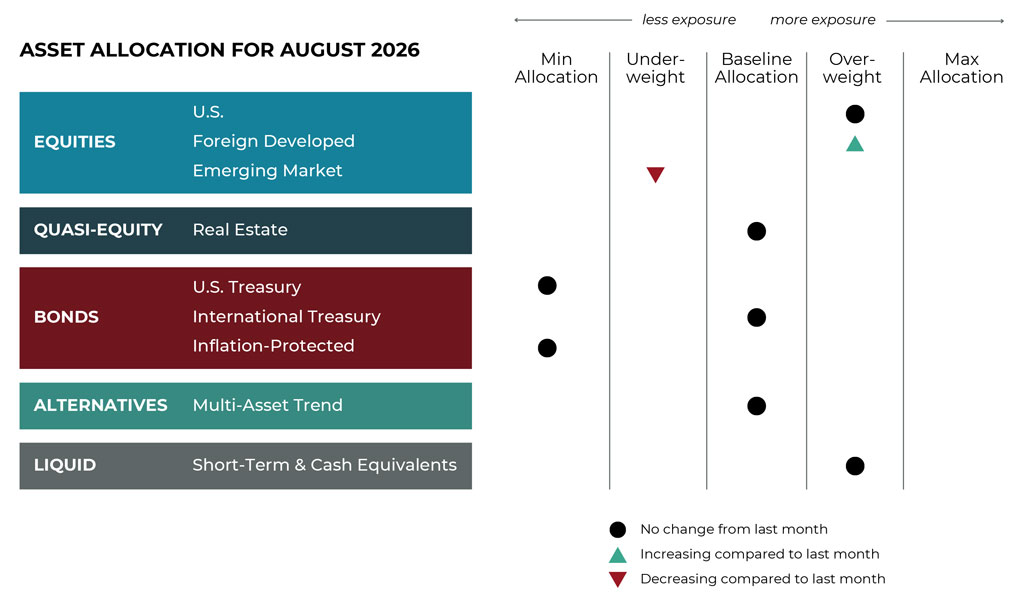
Source: Blueprint Investment Partners
Adjustments can vary across strategies depending on each strategy's objectives. What's illustrated above most closely reflects allocation adjustments for the Growth Strategy. Diversification does not guarantee investment returns and does not eliminate the risk of loss. Diversification among investment options and asset classes may help to reduce overall volatility.
U.S. Equities
Exposure will not change and remain overweight. Both the intermediate-term and long-term trends are positive.
International Equities
Overall exposure will not change and remain at baseline. However, emerging markets will move to underweight due to an intermediate-term downtrend. The removed exposure will be sent to stronger foreign developed, which will push it to overweight.
Real Estate
Exposure will remain at its baseline allocation as trends over both timeframes remain positive.
U.S. & International Treasuries
International Treasuries are now being partially expressed with an adaptive fixed income ETF. This will allow for continued baseline exposure and offer the ability to potentially benefit from both positive and negative trends. U.S. Treasuries of medium to long duration remain in downtrends across all timeframes and will continue to be underweight.
Inflation-Protected Bonds
Exposure will remain at its minimum with downtrends across both timeframes.
Alternatives
Short-Term Fixed Income
Exposure will not change and remain overweight, as this asset class continues to hold allocations from weaker fixed-income instruments.
Asset-Level Overview
Equities & Real Estate
The S&P 500 entered July coming off one of the best quarters in its history. Yet, after starting the month by moving higher, a breakdown in the ceasefire and an expansion of the conflict between the U.S. and Iran led to a decline. Despite the decrease and continued underperformance of the Magnificent 7, the S&P continues to enjoy an above-average return for the year thus far. As a result, trends over all timeframes remain positive and our portfolios will remain fully invested.
Like their domestic peers, international equities also fell in July, impacted by the same global uncertainty that affected the U.S. The decline was more severe, however, and with the combined effects of a pullback in technology stocks for regions such as Taiwan, South Korea, and China, it was enough to cause an intermediate-term downtrend in emerging markets. This exposure will be allocated to stronger foreign developed stocks, which remain in uptrends across all timeframes. The overall result will be a change in the emerging versus foreign mix, but there will be no change in the absolute level of international equity exposure.
Despite the challenges elsewhere in the equity space, real estate securities performed well, making multi-year highs. In fact, the unexpected rise has caused this asset class to become among the top performers year-to-date. Naturally, trends are positive which means our portfolios will remain at baseline allocation.
Fixed Income & Alternatives
It might be natural to assume equities falling and real estate securities increasing means a flight to safety has commenced that could benefit bond prices. In the words of legendary college football analyst Lee Corso, “Not so fast, my friend.” In fact, bond prices continued to decline in July, which has only entrenched existing downtrends. Consequently, our portfolios will remain minimally exposed and instead lean into ultra-short-duration instruments with low interest rate sensitivity.
Within the alternatives allocation, positioning is largely unchanged at the asset-class level. Fixed income continues to be net short while equities, commodities, and currencies remain net long. One notable directional shift occurred within commodities, where the grains exposure has flipped from net short to net long. The long position in metals has also been reduced as prices have declined, and the surge in the U.S. Dollar has caused the allocation to foreign currencies to decrease.
3 Potential Catalysts For Trend Changes
Consumer Prices: Inflation, as measured by the Federal Reserve, slowed in June but is still above the central bank’s 2% goal. This has led to speculation about how the Fed will act under its new Chairman Kevin Warsh. The Commerce Department reported that the personal-consumption expenditures (PCE) price index fell by 0.1% in June, mainly because energy prices dropped. Over the past year, PCE inflation was 3.7%, down from 4.1% in May. If you leave out food and energy, prices rose 0.1% in June, making the 12-month core PCE inflation rate 3.3%, a bit lower than May’s 3.4%. On Wednesday, July 29, the Fed kept interest rates unchanged, ending talk that this meeting might bring the first rate hike in three years. At a press conference, Warsh said the Fed is committed to fighting inflation.
Fed Meeting: The Fed kept its main interest rate steady at 3.5% to 3.75% with a 9-3 vote at the Meeting July 29. The panel released the same policy statement as in June, when rates were also unchanged. This means Chairman Kevin Warsh’s promise to bring down inflation remains untested for a second meeting in a row. After the decision, the 30-year U.S. Treasury yield rose to a 19-year high of 5.238%. The Fed’s move, along with its new, more reserved communication style, left markets unsure about what comes next. Three members wanted a rate hike, but most analysts expected rates to stay the same. Money markets had put the chance of a small rate increase at about one in three. Markets had fully expected a rate hike in September, but now that chance has dropped to 69%. For households, this means borrowing costs are unlikely to fall soon. The Fed’s rate mostly affects short-term loans like credit cards and auto loans, but mortgage rates and other long-term borrowing costs follow Treasury yields, which have been rising. The week prior to the Fed meeting, the 30-year mortgage rate hit 6.76%, the highest in almost a year, according to a Mortgage Bankers Association survey.
Housing: “There are a lot of things propping up rates right now,” said Redfin’s Head of Economics Research Chen Zhao, in reference to geopolitical conflict, inflation from artificial intelligence spending, and possible Fed rate hikes. “You are seeing that weigh on the housing market.” Mortgage rates dipped below 6% in February, raising hopes for a recovery in home sales after years of slow activity. However, the war in Iran pushed rates higher, and they have stayed volatile, keeping the housing market in a slump for a fourth year. Some economists say buyers have mostly adjusted to higher mortgage rates, but recent increases have still hurt demand. Redfin reports that U.S. pending home sales dropped to their lowest since early April during the four weeks ending July 26, falling 1.7% in just the last week. The housing market has struggled for four years since mortgage rates rose in 2022 and ended the pandemic buying surge. In June, the national median existing-home price rose to $440,600, up 1.8% from a year ago and the highest on record, according to NAR. Zillow’s Chief Economist Mischa Fisher said home prices are not rising as quickly as before, but incomes are growing, which is a good sign for home sales no matter where rates go.
The IPO Illusion: Why We Let the Market Lead
The stock market is a device for transferring money from the impatient to the patient.
—Warren Buffett
Few events generate as much excitement in the investment world as an IPO. The opportunity to own a company from the very beginning appeals to humans’ natural desire to discover the “next big thing.” This summer, no IPO captured more attention than SpaceX, one of the most anticipated public offerings in market history. The shares were priced to at $135, trading began in June, and in the early days intraday trading surged as high as $225 thanks to investor enthusiasm.
Not surprisingly, many of the clients we work with reached out asking the same question: Will Navigen Wealth Management own SpaceX?
Our answer was straightforward: not right away — and that’s intentional. That response often surprises people because it isn’t based on our opinion of SpaceX as a business. Instead, it reflects something much more fundamental about our investment philosophy: An IPO doesn’t have a trend yet.
Trend following is built on observable market behavior, not predictions. Our systematic investing process relies on price history to determine whether a security is establishing persistent leadership or beginning to weaken. On the first day — or even the first several months — of trading, there simply isn’t enough evidence. Thousands of investors are still determining what the company is worth, and prices are often driven more by emotion, limited share availability, and media attention than by an established long-term trend. As July winds down, SpaceX is trading below its IPO price and nearly 50% below its post-IPO high — a timely reminder of how quickly excitement can give way to reality.
In fact, research finds that since 2019 the average IPO has underperformed the broader market during the three years following its debut. Many companies entered the public markets during periods of exceptionally high valuations, optimistic growth expectations, and abundant liquidity. When interest rates rose and investor sentiment became more selective, many of those stocks struggled to justify their initial prices. Meanwhile, broad market indexes continued benefiting from a relatively small group of established market leaders.
This highlights an important distinction between investing and speculating. Investing asks, “How does this opportunity help me reach my long-term financial goals?” Speculating often asks, “What if everyone else gets rich without me?” That second question is driven by one of investing’s most powerful emotions: FOMO — the fear of missing out.
Most market cycles have a version of FOMO. Sometimes it’s internet stocks. Sometimes it’s cryptocurrency. Today it may be artificial intelligence or a high-profile IPO like SpaceX. While some of these opportunities eventually become outstanding investments, many are likely to fail to meet the enormous expectations placed upon them during periods of peak excitement.
At Navigen Wealth Management, our objective isn’t to own every exciting new investment. Our objective is to support clients to achieve their long-term financial goals through a disciplined, repeatable process. That means resisting the temptation to chase headlines simply because everyone else is talking about them.
If SpaceX ultimately develops into a sustained market leader, our systematic investing process is designed to recognize that. We don’t need to predict the outcome on day one. We can wait for the market to provide evidence.
In investing, patience is often mistaken for hesitation. We see it differently. Patience IS discipline. And discipline — not excitement — is what we believe gives investors the best opportunity to achieve lasting financial success.
Let's Talk
If you have any questions about what transpired in the markets last month or portfolio positioning for the month ahead